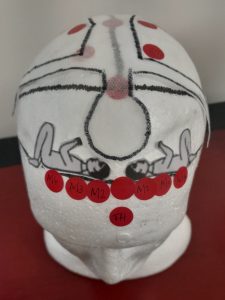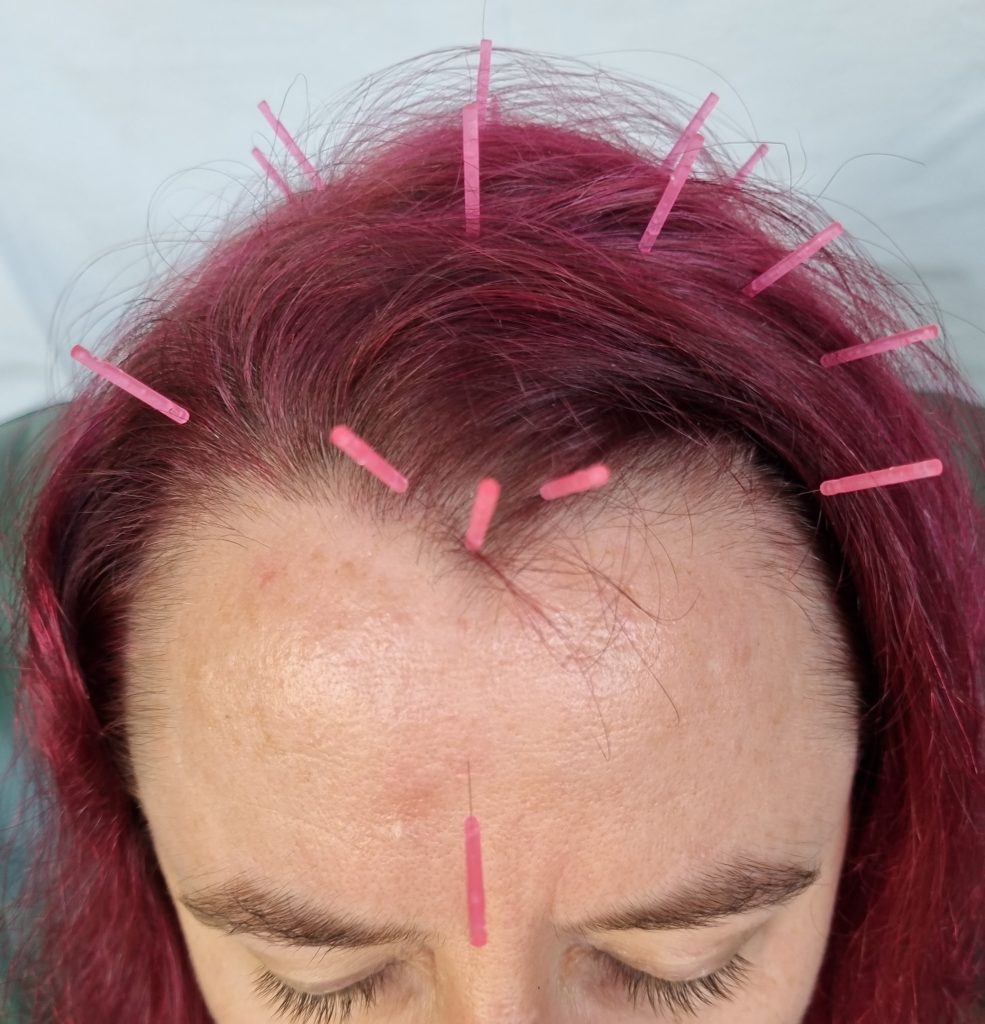
Image of a Needle Pattern for a client with “Left Shoulder & digestion issues”
Fang Style Scalp Acupuncture
This Blog relates to the clinical use by Dr Ryan of a form of Scalp Acupuncture. There are several styles of Scalp Acupuncture that are each based on a combination of known acupoints that occur on the scalp and specific areas that are matched to organs, body parts and senses. These are known as Scalp Microsystems. Dr Ryan has studied and used all the available styles, and now days prefers a style known as Fang’s Scalp Acupuncture. It has several benefits over the other approaches. It is quick to apply, and the needle retention time is quite short compared with the other styles. It is also has very good patient acceptance with very little discomfort during needle insertion and no repeated stimulation of the acupoints, through twisting or reinsertion etc that is required by other methods.
The Origin of Fang’s Scalp Acupuncture:
The origin of Fang’s Acupuncture is in the work of Dr. Fang Yun Peng, who was educated in Traditional Chinese Medicine and Acupuncture by his father. He graduated from the Medical School of Henan University in1936. He then served in the army as a surgeon. There was a significant lack of medication during the war and Dr. Fang was forced to use acupuncture to relieve postoperative pain in his patients. Being able to test his methods on thousands of patients, he developed his style of Scalp Acupuncture. The diagram shows a superimposed body face down on the scalp with the head area at the hairline, the arms spread down to the temples and the legs spread down to behind the ears. Dr Fang and his son Dr Fang Ben Zhong continued to use and research the system. It is estimated that between 1966 and 1972 they tested some 45,000 patients to determine correspondences between body parts and acupoints on the scalp. While it is a very prevalent style in China today it is not used greatly in the Western world.
Use of Fang’s Scalp Acupuncture:
Dr Ryan has studied this style and now uses it exclusively in all health conditions that may be benefited by the scalp approach. It is almost always applied in a seated position and when used alone without body acupoints, does not require removal of clothing. The benefits of the Fang approach are in its ability to treat a wide range of conditions from muscular skeletal strains and injuries, arthritis, including the inflammatory forms, migraine, disorders of the senses including vision, hearing, smell and taste issues. It is used in neurological illnesses such as Parkinson’s Disease and the recovery from stroke. It is also useful with respiratory and heart issues as well as allergies including asthma. It can be helpful with hypertension and disorders of the digestion, bowel and bladder. It often results in immediate pain relief and increased range of movement of affected joints
The Relationship with other Acupuncture Methods:
It also fits in very well with the 5 Element and Balance Method approaches used by Dr Ryan, that use points on the limbs and torso. The minimal discomfort means that it also very useful in children and is used for example, in learning issues, developmental delay and in disability in general. It is a very useful tool for patients with declining memory and for stress related symptoms such as anxiety, depression and neurodivergence. It is also very useful in assisting the ongoing maintenance of good health using a pattern of 11 Fang Acupoints. These cover the whole body and the stimulation of the main acupuncture channels. This can be further enhanced with the addition of 5 Element and Balance Method body points. Sessions take about 20 minutes to complete. The frequency of treatment depends on the patient’s issues. As with other acupuncture methods the sessions spread out with improvement in symptoms.